Covid mRNA Vaccine “ChulaCov19” Development Program
“LMICs have always been facing vaccine inequity during any pandemics. ChulaVRC’s mission is to join global effort on vaccine equity. The Covid vaccine development program has proven that building R&D and manufacturing novel mRNA vaccine capacity in Thailand is feasible through our leadership in managing local-global multi-parties, multidisciplinary, academic-private partnership, seeking big funding, managing Billion Baht scale of grant, and driving the program from upstream to downstream for pandemic preparedness and vaccine equity. ChulaCov19 generation-1 vaccine has been evaluated in clinical phase 1-2 and shown well tolerated with good immunogenicity; the generation-2 bivalent vaccine is on phase 2 trial in Australia and Thailand. Our commitment and achievement are well recognized by global media and top scientific journals. More importantly, with this established capacity, Thailand can join WHO-mRNA vaccine hub contributing to the next pandemics responses by producing quality mRNA vaccine in a fast, timely speed for vaccine access.”
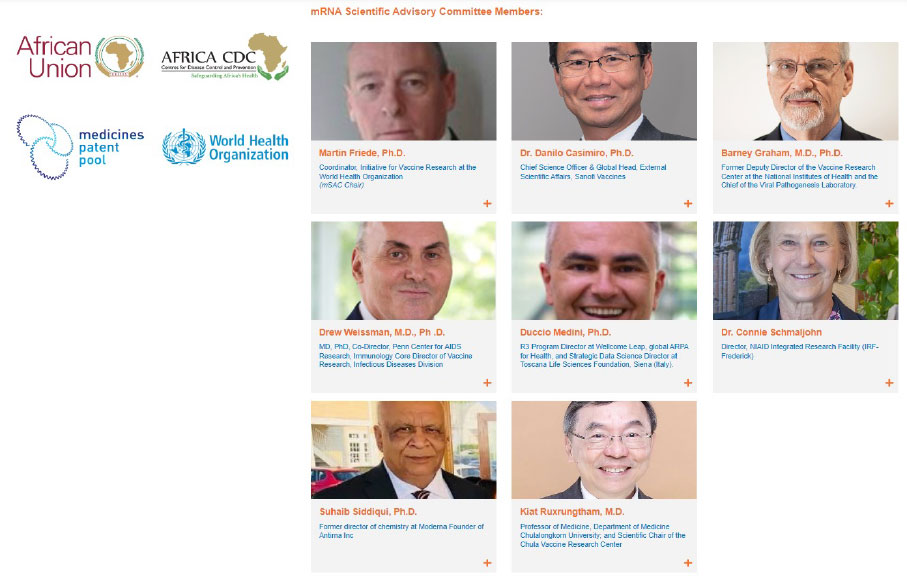
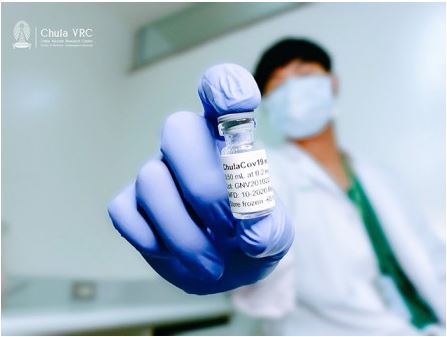
During any pandemics, LMIC countries have always been facing delayed and limited vaccine access. Public good-driven approach rather than current market-driven approach should overcome global challenged vaccine inequity. Building up vaccine R&D and manufacturing capacity in LMICs are thus important. ChulaVRC was founded in 2017 committed to join the global effort on vaccine equity. When Covid-19 pandemic started (early 2020), ChulaVRC in collaborating with Drew Weissman “the mRNA vaccine pioneer” at U. Penn has promptly developed a Covid-19 mRNA vaccine -named “ChulaCov19” and shown preclinically strong immunogenicity. This led to receiving public donation and the National Vaccine Institute grant to pursue to phase 1 trial. While developing mRNA vaccine manufacturing in Thailand, we contracted CMOs in the U.S. to produce ChulaCov19 clinical lot for clinical trials. The program started 1 month behind Pfizer and Moderna, but with slow speed because overcoming several major challenges are needed: licensing issues, competing for manufacturing slots, securing funding, ensuring QC, locked down, regulatory approval and coordinating trials. We started phase1 in June 2021, while Pfizer/BNT and Moderna received authorization in August. However, we pursue the program, because the goal is to build up our mRNA vaccine R&D and manufacturing capacity for the next pandemic and to solve other unmet need vaccine inequity issue. The ChulaCov19 (U.S. Lot) phase 1-2 results showed it is safe, well tolerated and elicited strong immunogenicity somewhat superior to the authorized mRNA vaccine. The outcomes were widely publicized on news globally and locally. The Thai Prime Minister had visited us 2 days later in August 2021 and granted us ฿2.3 Billion for manufacturing, clinical studies and if possible, for getting authorization. We partner with a Thai vaccine manufacturer “BionetAsia” and successfully manufactured same quality ChulaCov19 vaccine and showed in phase 1-2 trials in Thailand and Australia that it is well tolerated and elicited good immunogenicity. Due to the evolving of new variant “Omicron”, we thus have to develop Gen-2 bivalent vaccine, this time with a much faster speed when all capacity has been well set within the country. Our bivalent “Comvigen-WT/BA.4/.5) vaccine is now in phase 2 study in Australia and about to start in Thailand with overall N=520 (Early October). Our goal is to be able to deliver authorized vaccine against future pandemics in a faster speed together with WHO-mRNA vaccine hub to make vaccine timely accessible in LMICs. ChulaVRC is also developing other unmet need vaccines: Dengue, HPV, TB, allergy and cancer vaccines. Kiat is currently a scientific advisor of the WHO mRNA vaccine tech transfer hub and ChulaVRC is part of the Hub R&D consortium to make vaccine equity possible for pandemics and unmet need vaccines in LMICS.
In summary, the ChulaVRC Covid vaccine development program has proven that building R&D and manufacturing novel mRNA vaccine capacity in Thailand is feasible through our leadership in managing local-global multi-parties, multidisciplinary, academic-private partnership, seeking big funding, managing Billion Baht scale of grant, and driving the program from upstream to downstream for pandemic preparedness and vaccine equity.
BY
Chula Vaccine Research Center (Chula VRC), Faculty of Medicine, Chulalongkorn University
Related articles:







Others