DMIND (Detection and Monitoring Intelligence Network for Depression)
“In 2025, Thailand faces a severe mental health workforce shortage, with only ~822 psychiatrists and ~1,320 clinical psychologists, resulting in long waits, backlogs, and high dropout rates. The national hotline (1323) receives 400,000–600,000 calls annually but serves only ~100,000, leaving over 300,000 abandoned. To address this, we developed DMIND, an AI-powered prescreening mobile application that conducts structured interviews (9 HAMD-17–derived questions) via video, voice, or text. Users are classified into low, moderate, or severe risk; severe cases are connected to 1323 staff within 24 hours. From Apr 2022–Aug 2025, DMIND reached 392,464 sessions, enabling 11,919 severe users to receive care. We further integrated DMIND Voicebot into 1323, triaging 183,235 callers and reducing wait times from 40 to 12 minutes (~70%). Collectively, DMIND services supported 575,699 sessions, assisted 26,882 severe-risk users, and generated >300M baht in social and economic impact.”
In 2025, Thailand continues to experience a critical access gap in mental health services due to an insufficient workforce: the country has about 822 psychiatrists (≈1.25 per 100,000) and roughly 1,320 clinical psychologists, far below demand and unevenly distributed, producing backlogs, long waits, and patient dropouts. The national mental hotline (1323) receives 400,000–600,000 calls annually but can serve only ~100,000 because of staffing constraints; average waits are 30–40 minutes and more than 300,000 calls are abandoned, evidencing continuity-of-care risks.
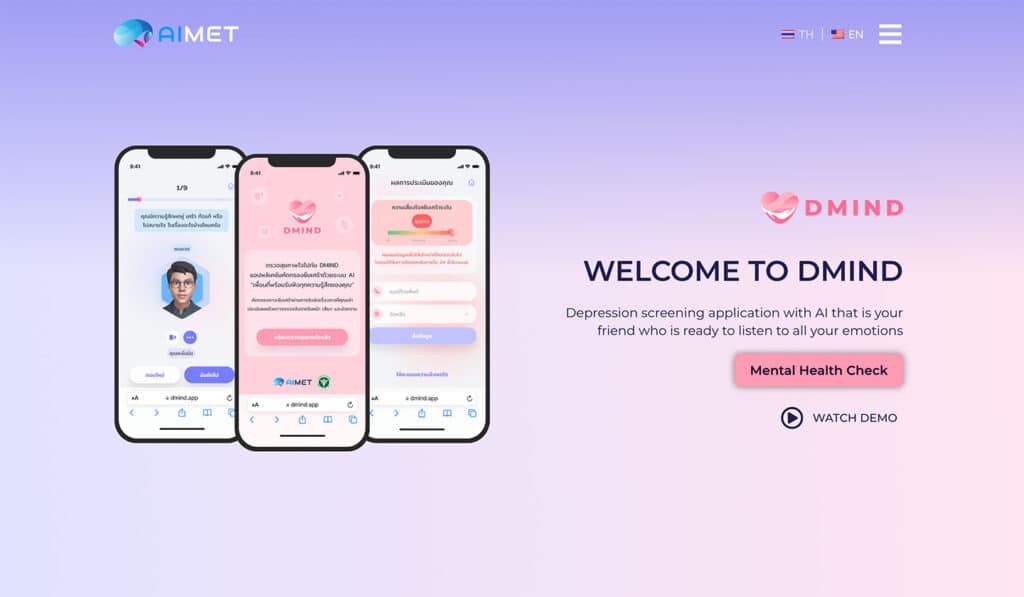
To mitigate this bottleneck, we develop an AI-based prescreening mobile application called DMIND to provide short and practical screening services. DMIND performs structured interviews by asking 9 questions derived from HAMD-17, which is a widely-accepted depression screening tool. Users can answer questions using video, voice, or text. Our AI then analyzes user inputs and classifies users into three risk levels: low, moderate, and severe. Users with severe-levels will be asked for phone numbers for staff from the Department of Mental Health’s national mental health hotline (1323) to call back within 24 hours.
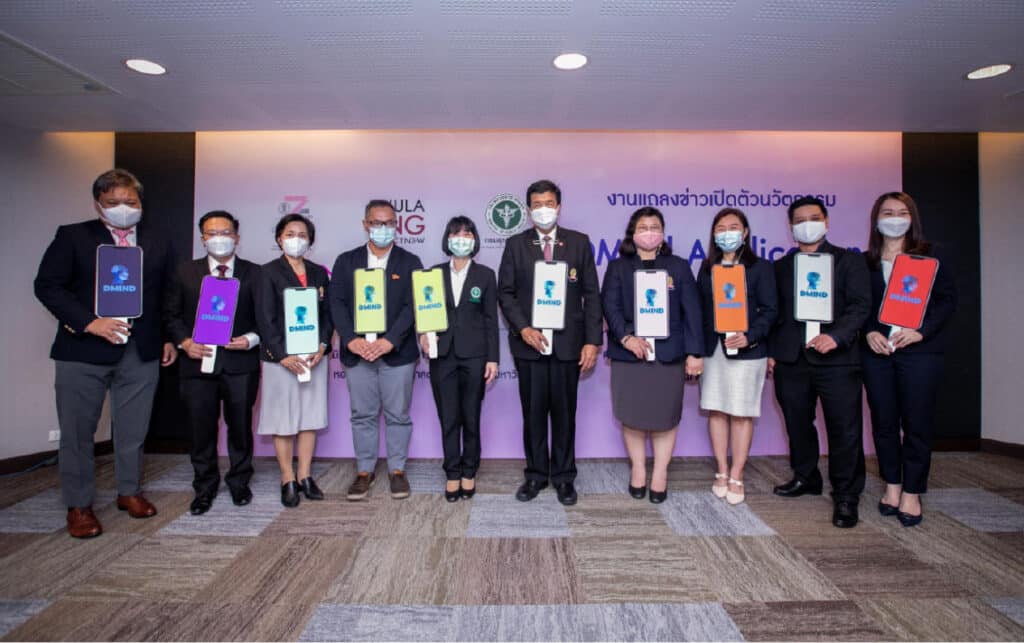
Our DMIND service has been developed in collaboration with the Department of Mental Health’s national mental health hotline (1323) and national platforms (MOHPROMT, NHSO, ThaiHealth), operationalizing a multi-agency public-sector partnership at national scale. As of August 2025, DMIND mobile application has been used in 392,464 sessions (Apr 2022–Aug 2025), leading to 11,919 severe-risk users to receive hotline support. This success comes from two important factors. First, our AI has been developed using a combination of technology designed specifically for our use case. We use a pre-trained Thai ASR model and fine-tuned with >120 hours of diverse Thai audio to understand people talking while crying or under stress. We utilize LLM to understand users’ answers and allow users to answer freely. In addition, we develop our own deep-leaning model that recognizes people with depression using features from facial action units. Current precision of our AI model for moderate and severe classes is 77%, with real-world challenges from environmental noise (traffic, television), crying, and disfluent speech.
To further improve 1323 services, we adapt our AI in DMIND mobile application to create DMIND Voicebot service, which is integrated directly into 1323 hotline services. While callers are waiting for services, our AI will interview the callers to triage callers into four risk levels, similar to DMIND mobile application. However, callers who have been determined by DMIND voicebot to be severe will be put into a priority queue, which enables them to reach 1323 call-center staff faster. During Jun 2024–Aug 2025, Our DMIND Voicebot has been used by 183,235 callers and 14,963 callers are determined to be severe. It effectively reduces average wait time from 40 to 12 minutes (~70% reduction).
In summary, our DMIND mobile application and DMIND Voicebot have been used in 575,699 sessions and benefited 26,882 severe-risk users to receive much-needed helps from Department of Mental Health’s national mental health hotline (1323). This leads to both social impacts for saving lives and economic impacts more than 300M baht
By
- Faculty of Engineering, Chulalongkorn University
- Faculty of Medicine, Chulalongkorn University





Others